Showing posts with label AMD PROCESSORS. Show all posts

10/21/2016

AMD FX-8320E | Review

AMD FX-8320E

At the point when AMD lets us know it's sending over another FX-Series CPU, we can't help the sudden surge of energy. It's a programmed reaction, conceived of a period when another AMD CPU could offer something truly focused.


Be that as it may, those days appear to be a distant memory. All we get now are contemptible updates of progressively elderly chips.


The FX-8320E is the ideal case of that. AMD discharged this chip before the end of last year, alongside the FX-8370E as a couple of lower-controlled octo-center CPUs for the more power-cognizant purchaser.

These two chips utilize AMD's Bulldozer processor tech and press into a 95W TDP. They're ready to do this by using a lower base clock, however holding similar Turbo clock as their non-E brethren.

Keeping that in mind, this FX-8320E is running at 3.2GHz as standard, with the capacity to hit 4GHz as required. The standard FX-8320's clockspeed sits about 300MHz higher at 3.5GHz.

As such, so great. For 30W less power you just yield 300MHz of CPU torque, which appears like a truly decent exchange off.

Be that as it may, the reality these CPUs are as yet running with an obsolete adaptation of the Bulldozer engineering makes them appear to be more similar to a bit of hindsight than a legitimate processor discharge. In the Kaveri APU, propelled a year back, AMD utilized the most recent modification of Bulldozer, codenamed Steamroller. Its next APU, Carrizo, will utilize the last Bulldozer modification which is codenamed Excavator.

This 95W processor then, utilizing the old Piledriver engineering, is two eras behind AMD's top x86 CPU centers.

Furthermore, it doesn't appear as though it has any enthusiasm at all in moving the FX extend over to the Excavator outline, regardless of the IPC (directions per clock) supports that both the Steamroller and Excavator tech have over Piledriver.

The cost of sparing 

What's the amusement with the FX-8320E then?

You'd expect that with the attention on hitting a lower TDP, this chip would take a gander at little frame consider machines, however that 95W TDP is still higher than the 84W Haswell Core i5 processors, even the K-Series renditions.

Be that as it may, then there's the cost. At simply over £100, this is the least expensive eight-center CPU around – regardless of the possibility that you shy away from alluding to its quad-module plan as a full octo-center setup despite everything it sits as the least expensive, eight-strung processor you can purchase.

In this specific circumstance, abruptly the FX-8320E resembles an all the more captivating buy.

That is particularly valid in case you're perched on a lower center check AM3+ chip and feel the requirement for a redesign. In execution terms – in both straight CPU and gaming tests – the FX-8320E is obviously behind both the FX-8350 and Intel Core i5-4570, however it's a decent £30-50 less expensive than those all the more capable chips.

Furthermore, on the grounds that it's an AMD chip, without the unnecessary constraints forced on it by exuberant showcasing executives (taking a gander at you, Mr Intel K-Series), you can get content with the overclocking. All things considered, ought to your picked chip and board be equipped for it in any case.

Our specimen wasn't extremely cheerful running anything above 4GHz. We received somewhat more in return with some voltage changes, however insufficient to keep it stable on the MSI 970 Gaming motherboard we were trying it in.

Still, at that speed on all centers it runs compelling near a stock-timed, full-fat AMD FX-8350.

For the AMD upgrader then, it's not a terrible spending alternative. In case you're hoping to assemble an all-new machine however despite everything we'd battle to suggest an AMD setup.

Despite the fact that you're getting eight strings of handling force, an unfalteringly quad-center, un-overclockable Core i5-4570 will even now convey better CPU execution, and in a littler power envelope as well.

The Intel stage is likewise going to be more up and coming and very little more costly either. While AMD's AM3+ chipsets were lining up for their annuities, Intel's motherboard chipsets were caught up with fitting themselves out with local USB 3.0 and PCIe 3.0 support…

And after that there's gaming.

In case you're a PC gamer, your AMD CPU is taking edges from your illustrations card. The contrast between the Intel Core i5-4570 and this FX chip is almost 20fps all things considered at 1080p settings with similar GPU. What's more, that is with a 50W pinnacle stage control sparing over the AMD offering as well.

Yes, it's at first a less expensive alternative, however you're paying an alternate cost going the AMD course.


Advantage

It's about the evaluating of this AMD CPU. At under £100 it's the least expensive eight-strung CPU you can purchase. In case you're into your multi-strung efficiency applications then the simultaneous execution of the FX chip's quad-module plan will convey a great deal of preparing influence for the cash.

What's more, you can overclock as well. Running at 4GHz you're getting nearly an indistinguishable level of execution from the pricier FX-8350.

Disadvantage

AMD's processor stage is looking genuinely geriatric nowadays. Without local support for either USB 3.0 or PCIe 3.0 it needs to depend on the board makers to get outsider silicon to manage such things. Also, that presents more execution hindrances.

Gaming is likewise an issue for the FX-8320e - you could conceivably miss out on a considerable measure of the execution capability of your illustrations card deciding on an eight-string FX chip over a quad-center Intel.

Verdict

As a spending eight-strung choice the FX-8320e is an average decision of chip for the profitability society, however in the event that you're hoping to fabricate a spending gaming rig you will miss out on a portion of the execution capability of your GPU.

https://amdgallery.blogspot.co.id/

10/16/2016

AMD Kaveri FX-7500 | Specificiation Review

AMD FX-7500

The AMD FX-7500 is a power effective ULV (Ultra Low Voltage) quad-center processor in view of the Kaveri engineering. It was uncovered in June 2014 for scratch pad and is made by GlobalFoundries utilizing a 28 nm SHP prepare. Notwithstanding having two CPU modules for a sum of four number centers timed at 2.1 - 3.3 GHz, the AMD chip additionally coordinates a Radeon R7 GPU timed at up to 553 MHz with 384 GCN shaders and a double channel DDR3-1600 memory controller.

Architecture 

Kaveri is the successor to the 2013 Richland engineering (e.g. A10-5750M). The reexamined CPU centers, codenamed Steamroller, speak to the third era of the module-based Bulldozer outline. Various significant changes incorporate adjusted decoders (now one for every whole number center), upgraded branch expectation, and expanded L1 I-store from 64 KB to 96 KB for each module. These amendments help the execution per clock somewhat over a comparatively timed Richland APU.

Performance

As per the clock rates, the FX-7500 offers a CPU execution like the Haswell-based Intel Core i3-4100U. By and large, the FX-7500 is adequate for every single day by day workload (Office, Internet perusing, interactive media) and additionally light multitasking.

Graphics

The Radeon R7 (Kaveri) GPU of the FX-7500 components a center clock of up to 553 MHz and 384 shader units. Since the GPU depends on AMD's GCN 1.1 design, both DirectX 11.2 "Level 2" and Mantle are bolstered. Moreover, the GPU can be utilized for universally useful processing as a part of different applications, for example, Adobe Photoshop by means of the OpenCL API.

As far as 3D execution, the GPU is generally as quick as a devoted GeForce GT 720M and can deal with numerous present amusements at low or medium settings at (W)XGA determination.

Power Consumption 

The power utilization of the whole APU is evaluated at 19 Watts, which is to some degree over the Haswell ULV CPUs from Intel (15 W including chipset). In any case, the FX-7500 is suited for 12 - 13-crawl scratch pad or bigger.

Specificiations


Manufacturer AMD
Series AMD Kaveri
Codename Kaveri
Clock Speed Rate 2100 - 3300 MHz
Level 2 Cache 4096 KB
Threads 4/4
TDP/Thermal Design Power 19 W
Transistor Count 2410 Million
Manufacturing Technology 28 nm
Die Size 245 mm2
Socket BGA (FP2)
Features SSE (1, 2, 3, 3S, 4.1, 4.2, 4A), X86-64, AES, AVX, FMA, DDR3-1600 Controller
GPU AMD Radeon R7 (Kaveri) (496- 553 MHz)
64 Bit 64 Bit Support
Hardware Virtualization AMD-V
Product Link AMD Kaveri FX-7500
Launch 06-04-2014

https://amdgallery.blogspot.co.id/

10/15/2016

AMD A10-7860K APU | REVIEW

AMD A10-7860K |Introduction
It has been some time since we last included an AMD CPU or APU on these pages. Amid that break, numerous things have changed at AMD, with new CPU center outlines included both in AMD CPUs and AMD APUs. As of late, AMD has additionally discharged new coolers and APU SKUs with lower control utilization values, making it the ideal time to investigate what AMD right now has on offer.

AMD sent me their A10-7860K APU to take a gander at; an opened APU with a low 65W TDP packaged with AMD's new, noiseless coolers. The CPU divide of these APUs utilizes four "Steamroller" centers, AMD's most recent CPU center plan, which has the A10-7860K clock up to 4.0 GHz with Turbo. The APU partition utilizes eight GCN centers that time in at 757 MHz. This isn't AMD's big cheese APU, that is without a doubt (that assignment is held for the A10-7890K), however consolidating a 65W chip with a cooler supposedly ready to handle 95W is an incredible blend of usefulness, while conceivably likewise peaceful. There is obviously a touch of overhead in that cooler's potential.

AMD's APUs are an esteem arranged suggestion. They aren't the quickest things out there, yet estimated at just US$125, they do offer genuinely great blast for your dollar. The question is whether these favor amazing failure control Godavari APUs experience their cases? Is AMD's new APU cooler really quiet? I took the risk to discover.

APU Features 

The new, productive, and able AMD A10-7860K APU 
The new A10-7860K processor conveys its execution at a low 65 W TDP. With a base clock of 3.6 GHz and a most extreme Turbo clock of 4.0 GHz, the AMD A10-7860K APU offers better than average execution with not too bad power utilization.

New, quite and powerful coolers: 
AMD asserts their new warm answers for "produce short of what one-tenth the commotion of their antecedents," making them "essentially noiseless." You can discover them packaged with the new A10-7860K APU I'm taking a gander at today and the A8-7670K and A8-7650K APUs.


With both the CPU and GPU parts having similar memory interface, framework memory paces are essential. AMD discharged a few distinct velocities of AMD Radeon Memory to run with your APU. Going from 1600 MHz to 2133 MHz, another new change are the higher memory speeds out of the crate with more up to date AMD Elite A-Series APUs. The AMD A10-7860K, for instance, underpins memory velocities of up to 2133 MHz to permit your opened APU to play out as well as can be expected.


AMD gave me a few slides to run with a past audit that portray the execution increments offered by utilizing 2133 MHz memory. I've incorporated these for you to investigate, and general testing shows the increments to net a detectable pick up.

Dual Graphics 
Similarly as with other AMD APUs, the AMD Elite A-Series A10-7860K APUs bolster Dual Graphics. This ought to permit you to combine your AMD A10-7860K with a discrete AMD Radeon R7 representation card to get a simple help in 3D-rendering execution. The slide appeared above is for more seasoned APUs since AMD's momentum media slides were not accessible on their site. In any case, the above slide offers a conventional thought of what you can expect by including a low-control VGA in with the general mish-mash.

Cooling Design


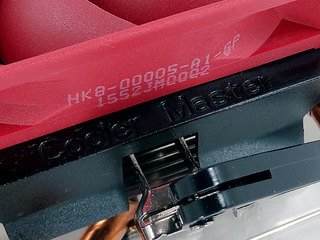
The cooler AMD included with the A170-7860K APU is all-new, made most evident by the red fan roosted up top. A gander at the edge that holds the fan uncovers this cooler to be by Cooler Master.

The fan is PWM-controlled, fitted with a 4-stick plug that mates with most motherboard CPU fan headers. This permits the fan to be powerfully controlled, in view of the cooling needs as directed by the motherboard.
The primary "meat" of the cooler comprises of an arrangement of uniformly divided blades that span up from the cooler's base to re-coordinate wind stream toward the VRM and memory segments of your system.The cooler uses an ordinary locking component to effortlessly mount onto any FM2+ motherboard right now available with no extra equipment. There is a substantial strong metal base with pre-connected warm glue to help in the simplicity of installation.There are two copper heatpipes that go over the center of the metal baseplate in contradicting bearings, which scatters the warmth equally all through the balances.
Those blades are formed to oblige the heatpipes, with molded balances at the cooler's edges to all the more successfully exchange warm. AMD's new cooler is clearly astutely intended to meet its 95W rating.

On the off chance that you set the fan to keep running at maximum capacity, you will hear some commotion because of the measure of air being moved, yet that clamor is for the most part brought about via air hurrying by the cooler's balances and onto the board's VRM and framework memory, with the fan's engine emanating a little measure of it.
And, after its all said and done, it is not boisterous, albeit unquestionably discernable over the default fans I have introduced into my Corsair Carbide Air 540, which is because of the fan's engine transmitting a generally sharp murmur.

The cooler figured out how to keep my A10-7860K beneath 50°C at stock timekeepers, regardless of what sort of load I tossed at it. I likewise saw (utilizing an IR thermometer) that the cooler stayed truly cool, with the board's VRMs being much more sweltering, around 27°C more blazing, in fact.

Specificiations

Manufacturer AMD
Model A10-7860K with Radeon R7 Graphics and Near Silent Thermal Solution
Tech/Package 28nm, FM2 + SOCKET
TDP/Thermal Design Power 65 Watts
Memory Dual Channel DDR3 2133
Graphics Core 8 GCN Cores(512 Stream Processors), DirectX 12
Key Graphics Features
  • AMD App Acceleration 
  • AMD Catalyst Software
  • AMD Enduro Technologies
  • AMD Frame Rate Target Control
  • AMD Free Sync Technology
  • AMD HD3D Technology
  • AMD Mantle API
  • AMD Power Tune Technology
  • Dual Graphics
  • AMD True Audio Technology
  • AMD Zero Core Power Technology
  • Switchable Graphics Mode
  • Vulkan API Support

So, that's all about AMD A10-7860K APU Review. Hopefully the content can show you information when you looking for.

https://amdgalery.blogspot.co.id/

10/14/2016

AMD A4-5000 | Specificiation REVIEW

AMD A4-5000

The AMD A4-5000 is a mobile quad-center SoC for low-end Notebooks, which was exhibited in mid-2013. Notwithstanding 4 CPU centers with a clock speed of 1.5 GHz (no Turbo), the 28-nanometer chip additionally coordinates a Radeon HD 8330 GPU, a solitary channel DDR3(L)- 1600 memory controller and in addition the Southbridge with different I/O-ports.

Architecture

Both Kabini (for note pads) and Temash (tablets and smaller subnotebooks) depend on AMD's new Jaguar design, which replaces the past Bobcat models (e.g. the E-350). As per AMD, the execution per clock has been expanded by around 15 percent. Besides, different cutting edge direction set expansions, for example, SSE up to adaptation 4.2, AVX and AES are presently upheld. The better 28-nanometer prepare from TSMC permits bring down voltages and/or higher clock rates contrasted with Bobcat, and in addition up to 4 CPU centers (Bobcat: 2 centers).

Performance

Because of the low clock speed of 1.5 GHz, the execution in inadequately parallelized applications is very unassuming and only somewhat over the old E2-1800. In any case, if every one of the 4 centers are occupied, the execution breaks even with the Sandy-Bridge-based Core i3-2377M. For office and sight and sound undertakings, the A4-5000 has adequate power; notwithstanding, it will achieve its points of confinement in all the more requesting applications and diversions.

Graphics

The SoC incorporates a Radeon HD 8330 GPU with 128 shaders, which depends on the GCN engineering and timed at 500 MHz (no Turbo). By and large, the HD 8330 matches a Radeon HD 7470M or Intel HD Graphics 4000. Numerous late recreations (starting 2013) are accordingly scarcely playable. Notwithstanding, some more established or less requesting amusements will run easily.

Power Consumption
The power utilization of the whole SoC is appraised at 15 watts. Along these lines, the A4-5000 is more practical than its antecedents (E2-1800: 17 watts) and reasonable for littler subnotebooks.

Specificiation

Series AMD A-SERIES
Codename Kabini
Clock Rate 1500 MHz
Level 1 Cache 256 KB
Level 2 Cache 2048 KB
Threads 4/4
TDP/Thermal Design Power 15 Watts
Manufacturing Technology 28 Nm
Features SSE (1, 2, 3, 3S, 4.1, 4.2, 4.2A) X86-64,AES, AVX, DDR3L-1600
64 Bit 64 Bit Support
Hardware Virtualization VT
Launch 05-23-2013

So, that's all about AMD A4-5000 Review. Hopefully the content can show you information when you looking for. 
See you next time.

https://amdgalery.blogspot.co.id/

AMD A8-7670K | REVIEW

AMD A8-7670K

Give us a chance to show you concerning the experience we had looking into AMD's A8-7670K APU. It arrived in a minor minimal white box. Probably not the retail bundling. God, we should want to think not. Despite the fact that judging by AMD's absence of advertising offer, this could be the genuine article. It's unrealistic to advise whether the 7670K went to another analyst before us. Anyway, in the wake of setting up our standard test stage, we introduced the chipset and started our preparatory testing.

Generally speaking, the processor has a sum of two computational centers, giving four strings. Say what you like in regards to register centers, AMD, yet Prime95 and Cinebench don't deceive us, and this processor is a remarkable moderate processor. Sadly, with 60% of the CPU taken up by the graphical side of things, the general execution in these applications is still very constrained.


That clarifies why, despite the fact that the 7670K tickers a normal of 3.6GHz at max, we accomplished some truly fair benchmarks when it came to computational undertakings. Indeed, we exited it to finish our 30GB chronicle test, however in the wake of taking 30 minutes to finish 49%, we figured it would be a superior utilization of our opportunity to stop the procedure and proceed with our different benchmarks.

So started the assignment of introducing the Nvidia GeForce GTX 980 (which we use on the greater part of our institutionalized surveys) close by AMD's most recent advertising. We toss the card in. It boots, solidifies, then dark screens. Also, won't get the show under some other situation.

Why are we bringing this up? All things considered, this is all part of the client encounter. You'll hear individuals specify how you're intended to drop as much cash as you can into the GPU and not the CPU. Be that as it may, maybe you chose to take a section level Nvidia GPU with your modest as chips AMD processor. In which case, you might just face these same issues we're confronting here. It's awful, yet we push on, now just having the capacity to finish a direct partition of our benchmarks.

Time to resign 

The most concerning issue here is the reality this is still a processor based off a just about five-year-old design. It's exclusive 28nm. It has constrained SATA 6GB/s bolster – and proceeds to just bolster DDR3 up to 2,133MHz, despite the fact that it's the one stage that would benefit the most from those expanded memory speeds.

The rundown goes on. Intel may just be increasing execution by 10% consistently, however the most essential thing it's including is chipset upgrades. This powers makers to upgrade their mobos, and thus give additional development, stockpiling choices and more current elements. For hell's sake, it's justified, despite all the trouble if just for the plan reboots a considerable measure of these sheets get.

In gaming, the circumstance isn't greatly improved. Yes, you can run titles like Dota 2 at worthy edge rates at 1080p (if 20-30fps is adequate to you), however unless you're just playing basic diversions and MOBAs, you're not going to get much happiness from it. For examination, in Shadow of Mordor it accomplished a normal edge rate of only 4fps at 1080p. A GTX 950 dealt with a normal of 33fps.

Advantages 


AMD's A8-7670K can run straightforward diversions at tasteful casing rates, and it's extraordinary for essential regular processing undertakings. The motherboards are simple on the bank adjust, and you have the additional advantage of low power utilization to hold that power charge down.

disadvantages 

This CPU depends on a half-decade old design, and is restricted from multiple points of view in light of this. We saw unremarkable to poor benchmarks when it came to figuring undertakings, and gaming tests likewise fell rather level – this is truly an item focused at portable PC clients as opposed to those with desktop PCs.

Verdict

We comprehend this is a £82 processor and you shouldn't expect an extraordinary arrangement at this value point. Be that as it may, for similarity, convenience and execution, you'd do as such much better to head somewhere else. That is the pitiful truth, and it's stressing for the fate of AMD.

So, that's all about AMD A8-7670K Review. Hopefully the content can show you information when you looking for.

https://amdgalery.blogspot.co.id/

10/05/2016

AMD FX-7500 | REVIEW

WHAT IS THE AMD FX-7500?

The AMD FX-7500 is a force productive ULV (Ultra Low Voltage) quad-center processor in view of the Kaveri engineering. It was uncovered in June 2014 for scratch pad and is fabricated by GlobalFoundries utilizing a 28 nm SHP process. Notwithstanding having two CPU modules for an aggregate of four number centers timed at 2.1 - 3.3 GHz, the AMD chip additionally incorporates a Radeon R7 GPU timed at up to 553 MHz with 384 GCN shaders and a double channel DDR3-1600 memory controller.

Design

Kaveri is the successor to the 2013 Richland design (e.g. A10-5750M). The updated CPU centers, codenamed Steamroller, speak to the third era of the module-based Bulldozer plan. Various significant changes incorporate adjusted decoders (now one for every number center), advanced branch expectation, and expanded L1 I-store from 64 KB to 96 KB for each module. These updates support the execution per clock somewhat over a likewise timed Richland APU.

Performance

As per the clock rates, the FX-7500 offers a CPU execution like the Haswell-based Intel Core i3-4100U. In general, the FX-7500 is adequate for every day by day workload (Office, Internet perusing, sight and sound) and also light multitasking.

Graphics

The Radeon R7 (Kaveri) GPU of the FX-7500 components a center clock of up to 553 MHz and 384 shader units. Since the GPU depends on AMD's GCN 1.1 design, both DirectX 11.2 "Level 2" and Mantle are bolstered. Moreover, the GPU can be utilized for broadly useful figuring as a part of different applications, for example, Adobe Photoshop by means of the OpenCL API.

As far as 3D execution, the GPU is generally as quick as a devoted GeForce GT 720M and can deal with numerous present recreations at low or medium settings at (W)XGA determination.

Power Consumption

The force utilization of the whole APU is appraised at 19 Watts, which is to some degree over the Haswell ULV CPUs from Intel (15 W including chipset). All things considered, the FX-7500 is suited for 12 - 13-inch journals or bigger.

Series AMD Kaveri
Codename Kaveri
Clock Rate 2100 - 3300 MHz
Level 2 Cache 4096 KB
Threads 4/4
TDP = Thermal Design Power 19 Watt
Transistor Count 2410 Million
Manufacturing Technology 28 nm
Bite the dust Size 245 mm2
Socket BGA (FP2)
Features SSE (1, 2, 3, 3S, 4.1, 4.2, 4A), x86-64, AES, AVX, FMA, DDR3-1600 Controller
GPU AMD Radeon R7 (Kaveri) (496 - 553 MHz)
64 Bit 64 Bit support
Equipment Virtualization AMD-V
Launch 06/04/2014
External AMD Kaveri FX-7500

So, that's all about AMD FX-7500 Review. Hopefully the content can show you information when you looking for.

https://amdgalery.blogspot.co.id/

9/25/2016

AMD E2-3000 | REVIEW

AMD E2-3000

The AMD E2-3000 is a portable dual-core Processor for low-end subnotebooks, which was exhibited in mid-2013. Notwithstanding 2 CPU centers with a base clock velocity of 1.65 GHz (no turbo), the 28-nanometer chip additionally incorporates a Radeon HD 8280 GPU, a solitary channel DDR3L-1600 memory controller and also the Southbridge with different I/O-ports.

Design

Both Kabini (for journals) and Temash (tablets and smaller subnotebooks) depend on AMD's new Panther design, which replaces the past Wildcat models (e.g. the E-350). As indicated by AMD, the execution per clock has been expanded by around 15 percent. Besides, different present day guideline set augmentations, for example, SSE up to variant 4.2, AVX and AES are currently upheld. The better 28-nanometer process from TSMC permits lower voltages and/or higher clock rates contrasted with Catamount, and up to 4 CPU centers (Wildcat: 2 centers).

Performance

Contingent upon the application, the execution of the E2-3000 is some place between a Pentium 2129Y and a Celeron 867. For office and sight and sound errands, the E2-3000 has adequate force; be that as it may, it will rapidly achieve its points of confinement in additionally requesting applications or multitasking.

Graphics

The SoC incorporates a Radeon HD 8280 GPU with 128 shaders, which depends on the GCN design. The center is timed at 450 MHz (no turbo). By and large, the HD 8280 places marginally beneath the HD Representation 4000 or a committed GeForce GT 520M. Just a couple of late diversions (starting 2013) are in this manner playable. Be that as it may, more established and less requesting recreations will run easily.

Power Utilization

The force utilization of the whole SoC is appraised at 15 watts. In this way, the E2-3000 is most appropriate for 12-inch journals or bigger.

Series AMD E-Series
Codename Kabini
Clock Rate 1650 MHz
Level 1 Cache 128 KB
Level 2 Cache 1024 KB
Threads 2/2
TDP 15 Watt
Fabricating Technology 28 nm
Features SSE (1, 2, 3, 3S, 4.1, 4.2, 4A), x86-64, AES, AVX, DDR3L-1600
64 Bit 64 Bit support
Equipment Virtualization VT
Launch 05/23/2013

So, that's all about AMD E2-3000 Review. Hopefully the content can show you information when you looking for.

https://amdgalery.blogspot.co.id/

9/24/2016

AMD E2-1800 REVIEW

AMD E2-1800


The AMD E2-1800 (codename Zacate) is a dual-core processor for little scratch pad and netbooks. It offers a moderately capable coordinated design card and a solitary channel DDR3-1333 memory controller. Contrasted with the more seasoned E-450, the E2-1800 offers just marginally higher CPU (50 MHz) and GPU (20-80 MHz) clock rates.

Inside the E2-1800 two Catamount centers can get to 512KB level 2 store for every center. In contrast with the Particle processors, the Catamount engineering utilizes an "out-of-request" execution and is along these lines speedier at the same clock speed. In any case, the execution is far more regrettable than comparable timed Penryn (Celeron) or Danube (Athlon II) centers. By and large the cpu execution of the E-450 falsehoods a bit past a Celeron SU2300 at 1.2 GHz or an Athlon II Neo K325 at 1.3 GHz.

The incorporated Radeon HD 7340 design card offers 80 shaders and an UVD3 video processor. Contrasted with the moderate GMA 3150 in the Iota processors, the HD7340 offers significantly more execution and is about as quick as the Nvidia Particle design arrangement. The distinction to the more established 6320 in the E-450 is a 20-80MHz higher clock rate.

The force utilization is evaluated with a TDP of 18 Watt by AMD. As indicated by first audits of Brazos models the force utilization was between 11 to 29 Watt. This would be on a level of a (significantly more capable) 11" MacBook Air utilizing Windows 7.

Series AMD E-Series
Codename Zacate
Clock Rate 1700 MHz
Level 1 Cache 128 KB
Level 2 Cache 1024 KB
Threads 2/2
TDP 18 Watt
Producing Technology 40 nm
Die Size 75 mm2
Socket FT1 BGA 413-Ball
Features MMX(+), SSE(1,2,3,3S,4A), AMD-V
64 Bit 64 Bit support
Equipment Virtualization AMD-V
Launch 03/20/2012

So, that's all about AMD E2-1800 Review. Hopefully the content can show you information when you looking for.

https://amdgalery.blogspot.co.id/

AMD E1-7010 REVIEW

AMD E1-7010

The AMD E1-7010 is a versatile quad-center SoC (codenamed "Carrizo-L") for section level gadgets and subnotebooks, which has been exhibited in May 2015. Notwithstanding 2 CPU centers timed at up to 1.5 GHz (help clock), the 28 nanometer chip additionally incorporates a Radeon GPU, a solitary channel DDR3L-1333 memory controller and the southbridge with different I/O-ports.

The antecedent AMD E1-6010 components comparable details aside from the slower clock speed (in any event help, as the 6010 tickers at 1.35 GHz without support), and the new FP4 bundle (perfect to the standard Carrizo SoCs). The speedier Carrizo-L SoCs (like the E2-7110) offer 4 CPU centers and a configurable TDP.

Design

Carrizo-L, Beema (for scratch pad) and Mullins (for tablets and minimal subnotebooks, same kick the bucket) depend on AMD's Puma+ engineering, which is the successor to the past Panther plan (Kabini and Temash APUs). Neither the execution per clock nor the list of capabilities (counting SSE up to 4.2, AVX and AES) have been changed. Be that as it may, AMD figured out how to decrease the spillage present, empowering fundamentally higher (support) clock speeds. This prompts a more responsive framework and better general execution. As its ancestor, the chip is made in 28 nm.

Performance

Because of the higher center recurrence, the 7010 ought to be quicker than the old E1-6010. Still, the SoC is suited for extremely fundamental errands like web surfing (very few tabs), word handling and video playback.

Graphics

The incorporated Radeon ought to be like the Beema based Radeon R2 GPU with 128 shaders. Just a couple of current recreations (starting 2014) are along these lines playable in low settings (see above connection for gaming benchmarks). A few diversions may likewise be restricted by the 2 centers at low recurrence.

Power Utilization

The force utilization of the whole SoC is evaluated at 10 watts. Therefore, the APU is likewise reasonable for little subnotebooks and can be utilized without a dynamic fan.

Series AMD E-Series
Codename Carrizo-L
Clock Rate 1500 MHz
Level 1 Cache 128 KB
Level 2 Cache 1024 KB
Threads 2/2
TDP 10 Watt
Transistor Count 930 Million
Producing Technology 28 nm
Socket FP4 BGA
Features MMX, SSE4.2, AES, AVX, BMI1, F16C, AMD64, VT
64 Bit 64 Bit support
Equipment Virtualization VT
Launch 05/07/2015

https://amdgalery.blogspot.co.id/

9/23/2016

AMD E1-6010 REVIEW

AMD E1-6010


The AMD E1-6010 is a portable dual-core SoC (codenamed "Beema") for passage level gadgets and subnotebooks, which has been exhibited in April 2014. Notwithstanding 2 CPU centers timed at up to 1.35 GHz (no help), the 28 nanometer chip additionally coordinates a Radeon R2 GPU, a solitary channel DDR3L-1333 memory controller and the Southbridge with different I/O-ports.

Engineering

Both Beema (for note pads) and Mullins (for tablets and reduced subnotebooks, same bite the dust) depend on AMD's Puma+ engineering, which is the successor to the past Panther outline (Kabini and Temash APUs). Neither the execution per clock nor the list of capabilities (counting SSE up to 4.2, AVX and AES) have been changed. Be that as it may, AMD figured out how to lessen the spillage present, empowering altogether higher (help) clock speeds. This prompts a more responsive framework and better general execution. As its antecedent, the chip is produced in 28 nm.

Execution

As the E1-6010 offers only two centers at up to 1.35 GHz, the subsequent execution is calm low. By and large, the APU is much slower than the old E1-2500 (1.4 GHz). Just basic workloads like Office, light Web scanning and sight and sound will be taken care of sufficient.

Graphics

The SoC incorporates a Radeon R2 GPU with 128 shaders, which depends on the GCN engineering and timed at up to 350 MHz. All things considered, we anticipate that the representation execution will be some place between the HD Illustrations (Straight Trail) and HD Design (Haswell). Current amusements (starting 2014) are in this manner scarcely playable even in low settings, just a couple of more seasoned and less requesting titels ought to run smoothly.

Power Utilization

The force utilization of the whole SoC is appraised at 10 watts. In this way, the APU is appropriate for little subnotebooks.

Series AMD E-Series
Codename Beema
Clock Rate 1350 MHz
Level 1 Cache 128 KB
Level 2 Cache 1024 KB
Threads 2/2
Max. Power Utilization 10 Watt
Producing Technology 28 nm
Features SSE (1, 2, 3, 3S, 4.1, 4.2, 4A), x86-64, AES, AVX, Single-Channel DDR3L-1333
GPU AMD Radeon R2 (Mullins/Beema/Carrizo-L) (260 - 350 MHz)
64 Bit 64 Bit support
Equipment Virtualization VT
Launch April 29, 2016
Item Interface AMD E-Series E1-6010

AMD A10-7870K REVIEW


AMD's battle against Intel hasn't been quite a bit of a battle lately. Attempt as it may, the fearless underdog has been upset at verging on each turn in its endeavors to outflank its monstrous adversary. A gander at every organization's accounts makes the reason plain. Intel's income is ten times more prominent, and its salary was $15 billion more in 2014 (AMD, in the interim, a couple of hundred million). It'd be dazzling if sheer brightness was sufficient to acquire achievement in the realm of silicon, however that hasn't been valid for no less than 10 years in a half.

Still, AMD does what it can, utilizing its points of interest to safeguard itself. The greatest weapon in this arms stockpile is, obviously, Radeon – the organization's GPUs stay aggressive at an assortment of value focuses. Thus the An Arrangement APUs officer on, consolidating process centers with Radeon equipment with expectations of making an adjusted, ease, multi-reason stage.

The APU's Radeon offers all the product points of interest AMD's discrete video cards.

That conveys us to the A10-7870K, the most recent APU in the organization's lineup. It offers four processor centers at a base clock rate of 3.9GHz (with a Turbo most extreme of 4.1GHz). They're joined by eight GPU figure units (for a sum of 512 Stream Processors) timed at 866MHz.

Sound great, isn't that so? It sounds better when the cost is considered; at $140, the A10-7870K is in accordance with Intel's most costly Center i3 double center desktop chips, and about $40 not exactly the minimum costly Intel Center i5. There's no debating that the A10 is reasonable – however is it truly a sensible other option to the inconceivably mainstream i5 quad?

Highlights

The A10-7870K is the most recent in a long line of processors sharing a typical stage, called FM2+, which initially showed up on the desktop in 2013. The design ancestry in truth reaches out back to 2011, however those prior processors were perfect with stages, for example, FM1, which are not good with these new processors. Still, AMD says that anybody with a FM2 or FM2+ motherboard ought to have the capacity to opening in the A10-7870K (or other new APUs), gave the motherboard producer issues a BIOS overhaul.
That is decent, however practically speaking it isn't quite a bit of favorable position over Intel. LGA 1150 showed up in 2013 also, all things considered, and there are in actuality new Broadwell processors – yet a set number – that will drop into that attachment. In addition, any AMD or Intel framework constructed two years prior is not needing an overhaul, inasmuch as the proprietor's needs haven't changed meanwhile.

A more solid favorable position over Intel is the 7870K's overclocking potential. The chip has an opened multiplier, which implies expanding the clock rate is somewhat straightforward, and a few clients have reported base clock speed increments as high as 4.7GHz. It'd not be right to call it "free" execution, as overclocking can disappoint, and a superior than-stock cooler might be need. Still, Intel has one and only opened spending processor, the G3258. While it's a take at $70, it's a double center without hyper-threading – a noteworthy impairment in numerous exceptional workloads, including most present day recreations.

Illustrations is AMD's other huge favorable position, obviously. We'll discuss execution soon, however there's a whole other world to it than that. The A10's Radeon GPU offers all the product focal points of a standard Radeon video card. That incorporates simple multi-screen bolster, FreeSync, and CrossFire, which permits synchronous utilization of the APU's design equipment with a discrete Radeon illustrations card for supported execution. The chip likewise appreciates better general driver support. Intel's driver discharges stay scanty and dreary. Radeon discharges are visit, and carry with them new elements, bug fixes and execution upgrades.

GEEKBENCH

The A10 brags a high clock speed and numerous centers, but at the same time it's burdened by the organization's processor design, which hasn't been comparable to Intel's lately. Geekbench makes the outcome of that self-evident.

battlefield 4 swung fiercely for AMD's APU.

Intel doesn't convey numerous specimens of its mid-range chips that may go up against the AMD A10-7870K specifically, so we don't have a desktop Center i3 to go up against it. We do, notwithstanding, have the organization's Next Unit of Figuring. These offer a Center portable processor and, when all out framework cost is considered, they fall right in accordance with what an AMD A10 framework may cost – which is to say, some place amongst $400 and $600. They additionally, similar to the AMD alternative, take into account littler frameworks liable to be utilized as a do-it-all family PC.

The reality this correlation isn't a victory for the A10 elucidates how far its design has fallen behind Intel. Both versatile Center chips win in single-center execution, and the i7 likewise wins in multi-center execution, regardless of that reality it's a portable rendition with two physical preparing centers (and Hyper-Threading, for four rationale centers).

Model Single-core Multi-core
AMD A10-7870K 2,224 6,203
Intel NUC Core i5-5250U 2,742 5,241
Intel NUC Core i7-5557U 3,251 6,786
Does this mean the A10-7870K is moderate? Not precisely. The level of execution it conveys is right in accordance with a common cutting edge Center i5 portable workstation, with somewhat better multi-center results. Few would call such a framework moderate, or even just satisfactory. Cutting edge chips, including AMD's, are more than equipped for taking care of everyday assignments.

However Intel has an unmistakable edge, and CPU execution is highly contrasting. Highlights contrasts are few, and for the most part insufficient to influence purchasers, so the snappiest chip is constantly best. The CPU execution story continues as before as usual – on the off chance that you need the best process execution for your dollar, Intel wins.

3D MARK

FutureMark's engineered test, 3D Mark, has a great notoriety as the go-to benchmark. It has reliably demonstrated to offer an initially gage of execution in various portable PC and video card surveys.

Model Score
AMD A10-7870K 6,270
Zotac ZBox Oi520 (HD 4400) 3,866
Dell XPS 13 (HD 5500) 4,961
Intel NUC Core i5 (HD 6000) 5,120

These outcomes paint a photo that is altogether for AMD. The A10-7870K figures out how to overcome the contending Intel items, and frequently by a wide edge, pretty much ruling out uncertainty about the Radeon GPU's prevalence in design. The main question now is the manner by which this will mean certifiable gaming. Will Intel increase back some ground?

World OF WARCRAFT

We start our testing with Universe of Warcraft. While the features encompassing this diversion have for the most part been about its tumble from notoriety, despite everything it has a bigger number of players than whatever other MMO in the western world, is still fifth on Raptr's most-played rundown.

Moreover, it's shockingly requesting, requiring more graphical snort than most titles on Raptr's main ten. That is particularly valid if newcomers like The Witcher 3 and Terrific Robbery Auto V, which will probably slide off inside a couple of months, are rejected. It may not look like much initially, but rather the amusement's long draw removes and nitty gritty situations make it significantly more requesting than its age recommends.

Model 1366x768 Low 1366x768 High 1080p Low 1080p High
AMD A10-7870K 94 44 94 33
Intel HD 4400 62 23 44 17
Intel HD 5500 78 21 51 15
Intel HD 6000 87 33 56 25
These outcome are firmly for AMD, much more so than 3DMark. Intel's HD 6000 (matched with a Center i5 portable chip) comes truly near the A10-7870K at 1,366 x 768 and low detail, yet increasing the determination to 1080p lets the APU stretch its legs. It conveyed framerates 40 percent higher than HD 6000 at 1080p and low detail, and it was the main choice to surpass a normal of 30 casings for each second at 1080p and high detail.
Progress: Past EARTH

The most recent amusement in the long-running Human advancement establishment isn't a graphical visit de-power, however it can be exceptionally requesting in late-diversion situations, and it's effortlessly among the most requesting methodology recreations available. Is the A10's execution out of this world?

Score another reasonable win for AMD. Its APU by and large deals with a 50-to-100-percent execution lead over the Intel HD 6000 arrangement, and it rules at high detail settings. At 1080p and high detail, for instance, it dramatically increases the execution of the HD 6000.

Civilization: Beyond EARTH

Model 1366x768 Low 1366x768 High 1080p Low 1080p High
AMD A10-7870K 63 32 44 24
Intel HD 4400 26 8 19 6
Intel HD 5500 32 11 28 8
Intel HD 6000 39 14 32 10
In any case, it's not all uplifting news. At 1080p and high detail the AMD chip midpoints 24 outlines for every second. Its base was as low as 14 edges for each second, which is exceedingly uneven. It'splayable, in light of the fact that Past Earth is a turn-based establishment that doesn't require snappy, exact info, yet it's not a perfect affair.

Battlefield 4

Our last diversion in this round-up is Shakers' epic present day military shooter. While it's presently a long way from the most requesting of recreations, War zone 4 remains a title that isolates the men from the young men, and in the past it has truly pounded Intel design. We should check whether AMD fairs better.

In a word; yes. AMD flees with the lead here, multiplying the execution of Intel HD 6000 at each determination and point of interest preset we tried. There's truly no challenge here.

Model 1366x768 Low 1366x768 High 1080p Low 1080p High
AMD A10-7870K 64 35 43 21
Intel HD 4400 18 9 9 5
Intel HD 5500 27 13 17 8
Intel HD 6000 27 13 16 8
However that triumph is at the end of the day clashing, as the A10-7870K doesn't figure out how to hit a normal of 30 casings for every second at 1080p and high detail. In a shooter, that truly matters – the diversion is playable, yet not charming. You'll have to settle for medium on the off chance that you'd like a smooth affair.

AMD BEATS INTEL HD, However IS IT ENOUGH?

The decision is clear. AMD's A10-7870K wipes the floor with Intel HD representation, presenting to twofold (and in some cases considerably more) the execution of the Intel options. It's conceivable that Intel Iris 6100 could perform better – yet our endeavors to test it were frustrated by mystifying execution drops and interesting graphical antiques, especially in Human advancement Past Earth. Keep in mind what we said in regards to AMD's unrivaled driver quality?

The A10-7870K annihilations Intel's representation, and frequently by a wide edge

Indeed, even in this way, the APU did not figure out how to hit 30 outlines for every second in two of the three diversions we tried. That is not incredible, and its exacerbated by the reality we utilized a lighter test suite than ordinary in this survey, as we'd accomplished for our Intel HD design round-up. Need to play Terrific Robbery Auto V, Shadows of Mordor or Crysis 3 at 1080p and high detail? You're going to require discrete illustrations. Remember that the A10-7870K speaks to the best execution AMD brings to the table in its APUs. Some less costly models have less stream processors and, all things considered, less execution.

That puts the A10 in an unbalanced position. Alone, it's sufficiently brisk to play around 3D recreations, however a long way from all, so it'll just request a certain sub-set of spending gamers intrigued by low-affect titles like Alliance of Legends and Diablo 3. To be reasonable, this isn't a little market. The vast majority of the amusements on Raptr's most-played rundown, or even Steam's most-played rundown, can be delighted in on the A10-7870K at 1080p determination and mid-to-high detail.

So, thats all about AMD A-10 7870K Processor Performance

https://amdgalery.blogspot.co.id/

9/21/2016

AMD FX-8350 Performance | Review

At the point when AMD was tossing around the specs of its first bulldozer chips we as a whole sat up and paid heed. All things considered, it was AMD's first new CPU innovation upgrade for a flat out age, and what it was anticipating doing with the new bulldozer microarchitecture looked really darned progressive.

Tragically for AMD however, its top chip could scarcely keep pace with the second level of Intel's Sandy Extension CPUs. At that point it discharged the 22nm Ivy Span kick the bucket therapist and things got much more hopeless for the Texan chip organization.

Purchase AMD FX-8350 at Amazon for $156.95

In any case, as we've seen in the course of the most recent couple of months, those AMD Bulldozer chips still have something to offer. Perhaps not the top-end eight-center FX-8150, but rather the colossal worth and overclocking abilities of the six-center FX-6200 made it an enticing prospect for anybody on a spending hoping to assemble a gaming rig.

Worth is center to this course of action, and having the capacity to assemble a better than average AMD CPU/mobo combo for not exactly a Center i5 setup implies that you get a decent piece of money to spend on your illustrations card. Truth be told, it's the contrast between having the capacity to get a HD 7950 or a HD 7870. Furthermore, we know which we'd rather have murmuring ceaselessly in our machine.

Presently, with the Piledriver redesign to the Bulldozer engineering, we have the most recent FX chips hitting the business sector under yet another codename: Vishera. Could the overhauled design close the hole on the Intel Ivy Span opponents, and give its CPU run an execution shot in the arm to match its worth qualifications?

Beat up

Strap in, I'm going to discuss engineering here. The first Bulldozer outline was a really radical movement as far as the change from the Stars design found in Phenom. It made Bulldozer modules with a couple of "centers" in every, sharing some lower usage silicon, for example, level-2 store, get and translate segments, while the more indispensable, time-touchy parts, for example, the whole number pipelines and level-1 reserve were a piece of every 'center'.

In genuine utilize however, this sharing of key parts implied that while multi-strung execution was enhanced, having such a large number of more strings of handling accessible implied the single-strung execution was slower even than the Phenom chips that went before it. That additionally implied gaming execution was down the pecking request, and the contending Intel chips left AMD trailing in their aggregate wake.

To attempt to change this, AMD has gone and done somewhat light rebuilding of the Bulldozer modules by means of this Piledriver redesign. We've seen the main execution of this new outline in the as of late discharged Trinity desktop chips, however this is the first occasion when we've seen it in a committed desktop plan.
Basically this isn't a noteworthy update - only a couple of genuine specialist satisfying changes, for example, better branch expectation, better equipment prefetching and enhanced planning. There are some other in the engine improvements, however with everything taken into account it's generally low-level stuff.

For the genuine design changes we must sit tight for the entry of the Steamroller overhaul some time one year from now. That is set to give the individual "centers" more devoted equipment to make them more like the conventional center configuration. Steamroller bends over the unravel motors in a module, and ought to make for enhanced single-strung execution.

Additional, additional

This isn't to imply that the new Piledriver plan doesn't include any additional execution for your money. Actually, this top-end FX chip is getting straight down to business at 4GHz out of the container. Eight AMD centers running at 4GHz - not very shabby.

Tragically however, the single-strung execution hasn't increase fundamentally, so don't get excessively amped up for gathering any additional gaming execution from this new chip.

The multi-strung execution doesn't see a colossal change either - in both fragments then we're taking a gander at around 15 for each penny additional handling rate. On the multi-threading side however, that slight return isn't as a lot of an issue on account of the amazing appearing of the first design.

When you consider that the new FX processors will be turning out at around the same kind of cost as the Bulldozer chips, that is not an awful cut of additional pace. What's more, with the fearlessly quad-center i5 3570K coming in around £20 more costly than this eight-string, quad-module FX-8350, will get a considerable piece more CPU execution straight out of the container.

Toss any multi-strung application at the two opponent processors and the AMD chip will soon demonstrate its strength in that field. With the i5 getting around the same kind of figures in Cinebench as the old FX-8150, the new Piledriver chip is somewhat more than 15 for each penny faster. That execution crevice gets significantly greater when you throw the HD encoding benchmark of X264 v4.0 at the pair with the FX-8350 getting just about 25 for each penny preferable results over the Intel i5.

Truth be told, on the off chance that you take the FX-8350's multi-strung execution in seclusion, it's all of a sudden getting somewhat near the execution of the comparably eight-strung god-like Center i7 3770K. In Cinebench the AMD chip is just somewhat more than 5 for every penny slower, and in X264 there's not exactly a solitary for every penny contrast between them. It's amazing that AMD has figured out how to close the execution hole this much in the multi-threading stakes.

With such a variety of present day efficiency programs truly exploiting the additional strings on offer in today's processors, there would be next to no arrival on the additional £100 you'd spend on the 3770K versus the FX-8350.

Tragically for AMD, we can't take the multi-strung execution of our chips in detachment. Single-strung ability still means a considerable measure, not slightest in gaming. What's more, in gaming the Intel CPUs still give significantly more - in our tests we were taking a gander at an additional 10-15 for every penny.

Benchmarks

As should be obvious from the benchmark comes about, the i7-3770K is still the top desktop chip on essentially all tallies, yet at £100 more than the most recent FX-8350 you're paying through the eye for that additional execution.

Contrasted and the correspondingly evaluated Center i5, the FX-8350 looks more great, capably beating it in any multi-strung test you give it. Truth be told it's entirely near the eight strings of the top Ivy Span CPU in those multi-strung measurements. In gaming terms however the Intel chips still hold a solid lead in crude CPU execution terms.

CPU rendering execution (single-string)

Cinebench R11.5: List score: higher is better

AMD FX-8350: 1.07

AMD FX-8150: 0.92

Intel Center i7 3770K: 1.63

Intel Center i5 3570K: 1.58

CPU rendering execution (multi-string)

Cinebench: R11.5 List score: Higher is better

AMD FX-8350: 6.71

AMD FX-8150: 5.71

Intel Center i7 3770K: 7.14

Intel Center i5 3570K: 5.70

CPU encoding execution

X264 v4.0: Outlines Every Second: Higher is better

AMD FX-8350: 41

AMD FX-8150: 35

Intel Center i7 3770K: 41

Intel Center i5 3570K: 33

CPU gaming execution

Batman: Air conditioning: Casings every second: Higher is better

AMD FX-8350: 114

AMD FX-8150: 126

Intel Center i7 3770K: 177

Intel Center i5 3570K: 164

CPU gaming execution

Shogun 2: CPU Outlines Every Second: Higher is better

AMD FX-8350: 25

AMD FX-8150: 22

Intel Center i7 3770K: 35

Intel Center i5 3570K: 34

Overclocking execution

Max OC: GHz: Higher is better

AMD FX-8350: 4.7

AMD FX-8150: 4.6

Intel Center i7 3770K: 4.7

Intel Center i5 3570K: 4.7

With money obviously being no article to any of us PC gaming sorts, we would dependably go for an Intel CPU to prop up the best representation card accessible. However, in the event that you don't have the unlimited pay of a PC tech journo (hack) then esteem for cash is completely key.

The reality remains that an AMD stage is less expensive than an Intel one, and that gives you more cash to spend on your GPU. With a superior GPU, the gaming execution picks up accumulated by the Intel CPU design turn out to be for all intents and purposes unessential. Your representation card is most in charge of your gaming background, so it bodes well to drop the most money on that.

Unleashed

Like the K Arrangement Intel chips, the whole FX extent is opened, so overclocking is unquestionably on the menu. All things considered, inasmuch as you have a respectable, OC-accommodating motherboard backing it up.

We struggled a touch of experiencing the BIOS of our Asus RoG board, however with the Windows-based AMD Overdrive programming we could hit 4.7GHz steadily. We could boot by means of BIOS overclocking, however once we began focusing on the chip it in the long run fell over.

With the AMD programming however, it remained joyfully numbercrunching endlessly. It's not exactly the 1GHz+ pace support you can escape Intel's engineering, however it gives you some noteworthy execution picks up. Running at 4.7GHz the FX 8350 is altogether quicker in multi-strung applications than even the i7 3770K at stock paces. Obviously, the Intel chip can likewise be overclocked, however it gives you some thought of how focused these AMD chips can be.

In a vacuum then, the Intel chips remain the main CPUs you'd need in your machines. They are the best at gaming, and the second-level quad-center chips stay focused with AMD's best in multi-strung applications. Be that as it may, this Piledriver redesign has shut the crevice a bit, and as far as stage worth in general, the AMD setup simply has the edge. Spend the distinction in CPU cost on a superior illustrations card and the execution contrast in recreations amongst AMD and Intel chips will in a split second dissolve away.

Like the Bulldozer discharge however, the top-level FX chip is most likely not the one that we'd truly prescribe. The £20 distinction in cost is immaterial, and wont have a gigantic effect in what GPU you go for.

The hex-center FX-6300, then again, could be a substantially more tempting prospect. On the off chance that evaluating takes after the past era then you're taking a gander at around a £70 contrast, and that could make for that knock up to a HD 7950. The hex-center chip will likewise overclock joyfully, so regardless you'll get not too bad multi-strung execution - effectively as proficient as the i5, for significantly less money.

An equally valued AMD hex-center machine then would improve for a gaming PC than an i5 3570K apparatus with a weaker GPU. We require AMD to be aggressive to keep the PC market dynamic, and keep Intel genuine.

These new Piledriver chips ought to have the capacity to do that, particularly at the quality end of the business sector. What's more, if that pushes Intel to improve chips - perhaps a standard six-center desktop CPU - then that is got the chance to be useful for everybody as well.

https://amdgalery.blogspot.co.id/

9/18/2016

AMD's FX-8370E processor explored

AMD's FX-8370E processor explored 

Eight strings at 95W 

From numerous points of view, AMD's FX processor arrangement appears to have fallen by the wayside of late. While An arrangement APUs were invigorated with new Kaveri silicon this past January, the FX family has been trucking alongside the same Vishera silicon since 2012. The going with 990FX chipset is a year more established and asking for a substitution. Now, one may have anticipated that AMD would let the FX family pass on a noble demise—then fill in the crevices with high-octane Kaveri APUs.

However, that is not what the organization did.

Rather, AMD has recently shaken up the FX arrangement with a trio of new models. The increases depend on the same Vishera silicon as some time recently, yet the enchantment of binning has yielded a quicker 125W top notch part and in addition two eight-center offerings with 95W warm envelopes. One of them, the FX-8370E, will be the subject of our survey toward the beginning of today.
Today's shakeup likewise includes a round of value cuts, the greatest one of which will send the family's 220W lead, the FX-9590, into the same waters as Intel's Center i5-4690K. Other value slices apply to the FX-9370 and FX-8320, which are both getting a bit less expensive.

Assembled, these are unquestionably the greatest changes AMD's FX line has found in well over a year. How about we take a gander at them one by one preceding we shoot our benchmarks.

When it turned out in June 2013, the FX-9590 could be discovered just inside select pre-manufactured PCs from framework integrators. It took several months for the chip to hit e-tail postings, where it at first sold for an overwhelming $880. By October 2013, the FX-9590 had tumbled to $350; and only before today's value cut, Newegg had it on special for $299.99.

Starting today, the FX-9590 ought to be accessible at e-tail for just $229.99. This value sets the FX lead against Intel's least expensive Demon's Gorge processor, the Center i5-4690K, which is accessible for $239.99. The Center i5 as a matter of fact expends a small amount of the force, at 88W, and accompanies a packaged heatsink and fan, which the FX-9590 does not. (AMD offers a form of the FX-9590 with a fluid cooler in the case, yet that unit will set you back $290 after these cuts happen.) Still, the FX-9590 is in a more aggressive position now than any other time in recent memory.

For clients threatened by the FX-9590's 220W force envelope, AMD has presented the FX-8370, its quickest 125W processor yet. Beside a 100MHz increment in pinnacle Turbo headroom, the FX-8370 has fundamentally the same specs as the FX-8350. Since the new model is $20 more costly, some might be enticed just to purchase the slower, less expensive chip and overclock it. All individuals from the FX arrangement, over a wide span of time, still have completely opened upper multipliers. The FX-8370 is AMD's first new awesome FX-8000-arrangement processor since October 2012, however, which must mean something.
The most fascinating increases to the lineup are these FX "E" chips. They present the same eight-center formula as the previously mentioned 125W sections, yet in a more sensible 95W force envelope.

95W FX processors with eight centers have been accessible some time recently, yet nowadays, the main ones still around are four-and six-center parts. AMD says it means the "E" chips to serve as moves up to those models inside frameworks that "don't generally have the base" to bolster a 125W CPU. Basically, somebody with a quad-center FX chip could supplant it with a FX-8370E and appreciate a sizeable execution support without requiring another motherboard, cooler, or force supply. Not even a BIOS redesign would be essential, clearly. AMD says "parts" of its clients have asked for a redesign way like this, and it was cheerful to oblige.

https://amdgalery.blogspot.co.id/

AMD 7th Era Processors

AMD seventh Era Processors: What You Have to Know 

On the off chance that you've been looking for a portable PC , you may have seen that a portion of the slightest costly offerings are fueled by AMD chips. Intel's fundamental rival in the tablet processor market guarantees better execution and much more grounded design speeds for the cash. Lamentably, the few AMD-fueled portable workstations we've assessed in the previous year, including the HP EliteBook 745, delivered disappointing results on our tests.

Be that as it may, AMD could soon be making a push into more standard tablets. This week, the organization authoritatively took the wraps off of its new seventh Era APUs (quickened preparing units), which guarantee gigantic upgrades in execution over its current sixth gen lineup of chips, especially to game and video. With several SKUs that interpretation of Intel's Center i5 and Center i3 straightforwardly, the new "Bristol Edge" processors could make it less demanding for spending plan cognizant customers to play easygoing titles at nice edge rates

Could an AMD APU be in your next tablet? Here are 7 things you have to think about AMD's new seventh gen processors:

1. All the more Value for the Money: AMD plans to give more execution, especially representation influence, at the same or preferred costs over its rival's mid-range or low-end CPUs. For instance, as per AMD, the A12 chip looks at positively to Intel's Center i5-6200U, offering 31 percent quicker gaming execution as measured by 3DMark 11.

2. Bristol Edge on the Top of the line, Stony Edge for Worth: AMD's seventh Era APUs are partitioned into two designs, with various codenames. The quicker chips, which are sold under FX, A12 and A10 model numbers, utilize the Bristol Edge engineering. The slower A9, A6 and E2 CPUs as in view of the "Stony Edge" stage. Bristol Edge chips. Both models bolster quick DDR4 memory, however Bristol Edge can take Slam that is up to 2400 Mhz while its slower sibling tops out at 2133 MHz. The higher-end chips additionally offer more execution improvements.

3. Ready for Cutting edge Video: All the An Arrangement APUs bolster 4K ultra HD in both the prominent H.264 and better than ever H.265 encoding groups. They additionally bolster Google's VP9 encoding at up to 1080p.

4. Immense Stride Up in Rate: AMD says that Bristol Edge CPUs are 56 percent speedier than its 2014 "Kaveri" chips while its Stony Edge processors are 52 percent quicker than their prompt antecedents.

5. HP Envy x360 Goes First: HP's new Envy x360 2-in-1 will be the main portable workstation accessible with an AMD seventh Era APU. This month, purchasers will have the capacity to purchase the x360 with either an AMD FX 9800P processor, an Intel Center i5 or an Intel Center i7.

6. 9 New SKUs: The organization has declared nine distinctive SKUs for its new processors. The FX, A12 and 10 are all accessible in both 15-watt (standard portable PC) and 35-watt (gaming/workstation) models, while the A9, A6 and E2 are just accessible with the lower wattage.


The FX and A12 chips both have the quickest GPU, the Radeon R7. The A10 and A9 utilize the slower Radeon R5, the A6 utilizes Radeon R4 and the E2 has a Radeon R2.

7. APUs Not CPUs: AMD calls its chips Quickened Preparing Units (APUs), since they highlight the organization's effective Radeon representation processors on the same bite the dust as the CPU. Intel additionally has incorporated illustrations on its CPUs, however doesn't utilize the APU wording.

http://amdtrustedreviews.blogspot.co.id/